
Our Carbon Portfolio
GREEN PETROLEUM COKE (GPC)
Green petroleum coke (GPC) is the solid carbon byproduct produced by the delayed coking process at petroleum refineries. It is one of the most important and widely traded industrial carbon commodities in the world, with annual global production exceeding 100 million metric tons.
"Green" in this context refers to the uncalcined state of the material — not an environmental designation. Raw GPC contains residual hydrocarbons and moisture that are removed during the calcination process.
Grades & Applications:
Anode Grade GPC
Low-sulfur, low-metals green coke that meets the quality requirements for calcination into carbon anodes for aluminum smelting. This is the highest-value GPC grade, commanding a premium over fuel-grade material.
- Sulfur: Typically <3.0% (specifications vary by calciner)
- Key quality parameters: Real density potential, sulfur, vanadium, nickel, moisture, volatile matter
- End use: Calcination → CPC → Aluminum anode production
Fuel Grade GPC
Higher-sulfur petroleum coke used as an economical, high-calorific-value fuel substitute in cement kilns, industrial boilers, and power plants. Fuel-grade petcoke has a significantly higher calorific value than coal, making it an attractive fuel alternative in energy-intensive industries.
- Sulfur: Typically >3.0% (varies by refinery and crude slate)
- Calorific value: 8,000–8,500 kcal/kg (higher than coal)
- End use: Cement manufacturing, power generation, industrial energy
Key Specifications We Manage:
- Sulfur content (%)
- Vanadium content (ppm)
- Nickel content (ppm)
- Moisture (%)
- Volatile Matter (%)
- Fixed Carbon (%)
- Ash content (%)
- Hardgrove Grindability Index (HGI)
- Real Density (g/cc)
Supply Sources:
Stanley Trading sources GPC from refineries across North America, Latin America, the Middle East, and Europe — including both major integrated oil companies and independent refiners operating delayed coking units.
SPECIALTY CARBON MATERIALS
Product Tag: Specialty
Headline: Carbon solutions for advanced industrial applications.
What We Can Source:
Beyond our core petroleum coke product lines, Stanley Trading has the market relationships and sourcing capability to supply a range of specialty carbon materials for specific industrial applications. Current and emerging capabilities include:
Carbon Black Feedstock (CBFS)
Aromatic oil feedstocks used in the production of carbon black for tire manufacturing and rubber products. Sourced from refineries producing suitable heavy aromatic oil fractions.
Electrode Carbon Paste
Carbon paste and Söderberg electrode materials for silicon, manganese, and other electro-metallurgical production processes.
Carbon Raiser / Recarburizer
Calcined petroleum coke and calcined anthracite used as recarburizers in steel-making and foundry applications.
Pitch Coke
Coke produced from coal tar pitch, used in specialty carbon and graphite manufacturing.
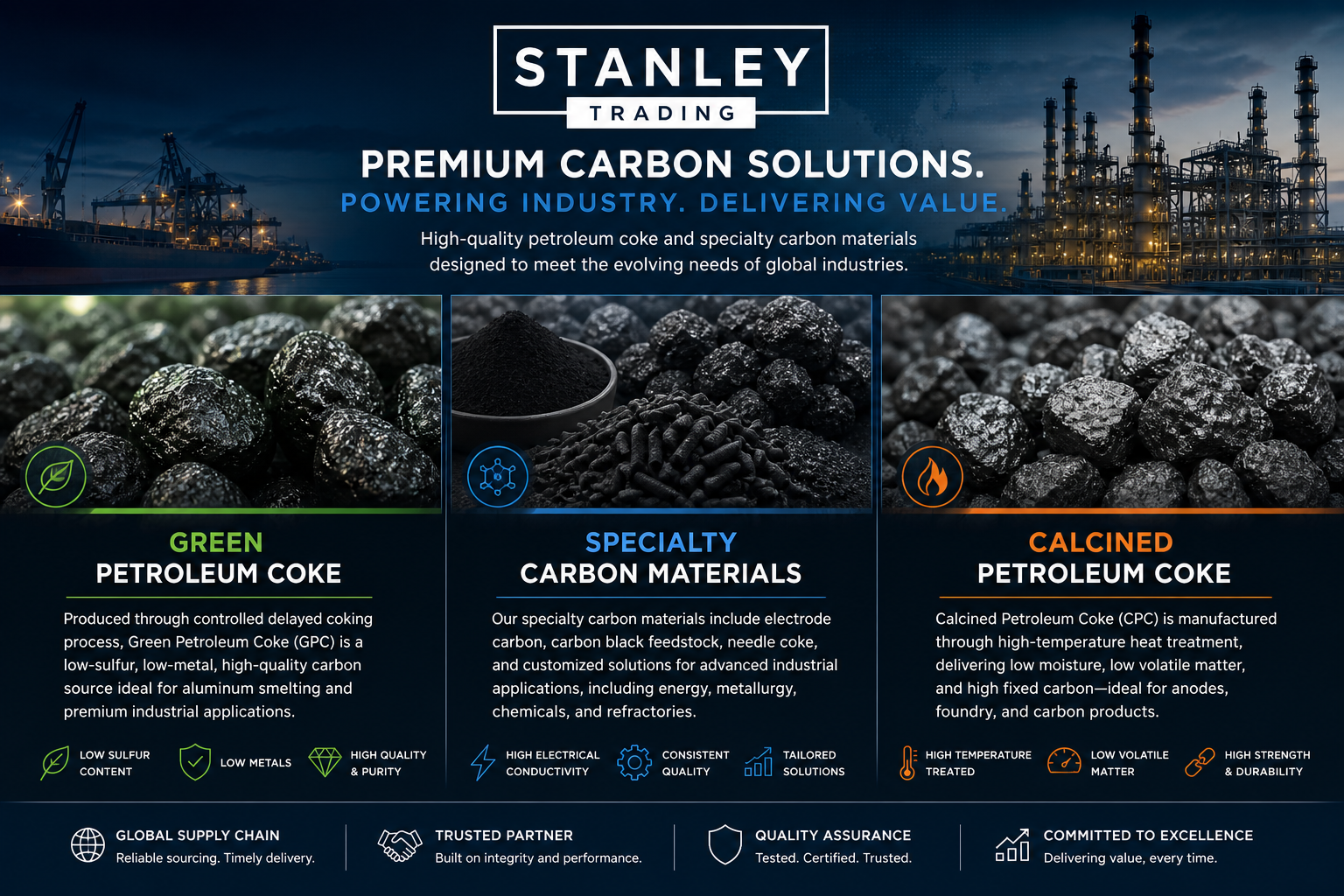
CALCINED PETROLEUM COKE (CPC)
(Premium Grade) Calcined petroleum coke (CPC) is produced by heating green petroleum coke in a rotary kiln to temperatures of approximately 1,200–1,350°C, driving off residual moisture, volatile matter, and hydrocarbons. The resulting material is a dense, electrically conductive carbon product that is the primary raw material for manufacturing carbon anodes used in aluminum electrolysis.
The aluminum industry is the world's largest consumer of calcined petroleum coke, consuming approximately 0.4–0.5 metric tons of CPC per metric ton of aluminum produced.
Grades & Applications:
Anode Grade CPC
Premium CPC meeting the quality requirements of aluminum smelters for carbon anode production. Strict quality specifications on sulfur, metals, real density, and electrical resistivity.
- Real Density: ≥2.04 g/cc
- Sulfur: <3.0% (smelter-specific requirements vary)
- End use: Carbon anode production for primary aluminum smelting
Recarburizer / Carbon Additive Grade CPC
CPC used as a carbon additive in steel-making electric arc furnaces and in foundry operations to adjust carbon content in molten metal.
- End use: Steel production, foundry operations, cast iron manufacturing
Carbon Paste Grade
CPC used in Söderberg electrode paste and carbon paste applications for steel and silicon carbide production.
Key Quality Parameters:
- Real Density (g/cc)
- Sulfur (%)
- Vanadium (ppm)
- Nickel (ppm)
- Silicon (ppm)
- Iron (ppm)
- Ash (%)
- Moisture (%)
- Electrical Resistivity (μΩm)
Supply Sources:
Stanley Trading sources CPC from world-class calciners operating in the United States, the Middle East, India, and other major calcining regions. We maintain relationships with both large-scale industrial calciners and specialty producers capable of meeting demanding quality specifications.